First grooves
For anyone starting from zero, at any age.
- Grip, posture and setting up the kit
- Your first beats and fills
- Reading basic drum notation
About me
I've been playing the drums since I was four years old, and sound has been at the centre of my life ever since.
I started teaching during the third year of my bachelor's degree, and I love helping drummers of all levels find their voice. My lessons cover everything from foundational rudiments to full grooves, with a strong technical focus on ergonomics, dynamics, timing, and tone. Because modern drumming goes far beyond just hitting acoustic shells, I also teach hybrid drumming and drum production, giving you the tools to shape, trigger, and record your own studio-ready sound.
Away from the kit, I work as an audio hardware engineer at Jaguar Land Rover, designing and implementing speakers and MEMS microphones. That engineering background deeply informs how I think about acoustics and tone on the drums. One of my favourite projects involved using acoustic metamaterials as an internal speaker absorber, achieving deep low-frequency extension from a much smaller enclosure than a conventional design allows.
Whether you're picking up sticks for the first time, looking to refine your technique, or trying to dial in your recording setup, feel free to reach out. I'd love to hear what you're working on.
Learning
Two ways in. Learn the drums with me, one to one. Or look inside the hardware I build for a living, starting with the tiny microphone in your phone.
Learning · Audio hardware
Your phone has three or four of these. Each one is about 3.5 by 2.7 mm and thinner than a grain of rice is wide. Here's one taken apart. Turn it around, pull it apart and tap any piece to see what it does.
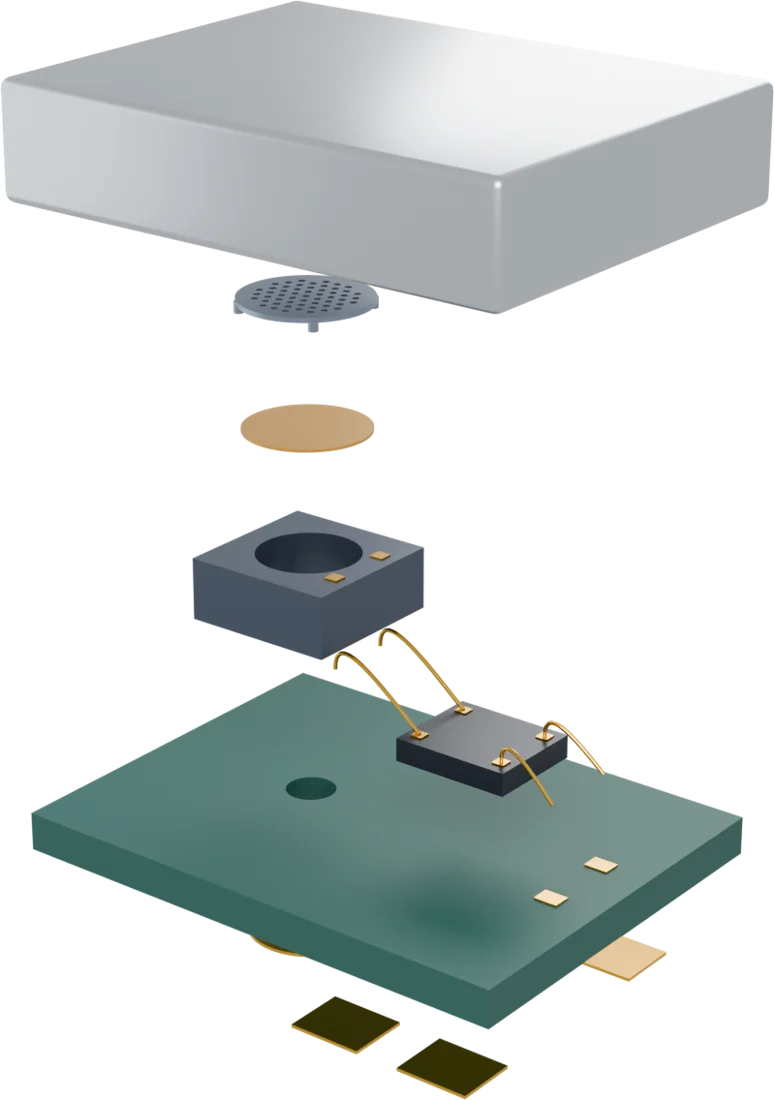
Drag to turn · tap a part
Turn air pressure into numbers. Pick a part to see how it helps.
A pressure wave comes through a hole in the phone's circuit board and up through the port in the substrate.
The pressure pushes the thin diaphragm by a few nanometres. The air trapped under the lid pushes back like a spring.
Diaphragm and backplate form a capacitor. As the gap between them shrinks and grows, so does the capacitance.
A charge pump holds the capacitor at a fixed charge, so a changing gap becomes a changing voltage. A preamp buffers it.
In a digital mic a sigma-delta converter turns that voltage into a fast stream of ones and zeros (PDM) for the phone to read.
I modelled this in Blender from the layout of a typical bottom-port mic, then brought it here. Sizes are close to real; the gaps between diaphragm and backplate are drawn about a hundred times bigger than life so you can see them. In a real part the diaphragm is around a micrometre thick and the gap is just a few micrometres.
Drum Lessons
Online lessons built around what you want to play. Every lesson ends with a short practice plan so you know exactly what to work on before the next one.
For anyone starting from zero, at any age.
Structured work towards a graded exam.
For drummers who feel stuck.
Rudiments on the pad to loosen the hands.
One idea, broken down and played slowly.
Put it to music at a tempo you can hold.
Three things to work on, with tempos.
Draft copy. The three lesson types and the lesson outline are placeholders for you to replace with your real offer, prices and booking link.
Drum Games
Two games: a note highway you play on your keyboard, and a timing test that measures every tap in milliseconds.
Notes roll down the highway towards you. Hit each one as it crosses the line, on your keyboard or the pads underneath. Clean hits in a row build a combo that multiplies your score, up to four times.
Esc pauses. With no song running you can still jam on the keys.
If almost every hit says Late, raise this. If they say Early, lower it.
Two ways to test your time. Steady beat: tap along with the click and get your timing back in milliseconds. Echo the groove: hear a cowbell pattern once, then clap it back, scored on what you remembered and how tight you played it.
Tap along with the click for 16 beats and see how steady your time is.
Squares are the cowbell groove, revealed after your turn; dashed squares are notes you missed. Bars are your claps: green within 30 ms, yellow within 60 ms, red further off. Hollow bars are extra claps.
Your best run on this device is saved here.
Bluetooth headphones and speakers add a delay that will make you look late. Use wired headphones or the device speaker for a fair score.
Sound Art
Sprinkle sand on a metal plate and vibrate it. At certain frequencies the plate resonates, and the sand is shaken off the moving parts and collects along the lines that stay still. Each frequency draws a different figure.
Tap or drag on the plate to pour more sand.
Turn your volume down before playing the tone. Pure tones get piercing above 2 kHz.
The lines where sand gathers are nodes: places where the plate is not moving at all.
Raise the frequency and the plate splits into more, smaller regions, so the figure gets more detailed.
A drum head does the same thing in circles. Those vibration modes are why a drum has a pitch and a ring.
This is a simulation of an ideal square plate, the kind Ernst Chladni bowed with a violin bow in 1787. A real plate's resonant frequencies depend on its size, thickness and metal, so the numbers here are illustrative.
Products
Practice material to use between lessons. Nothing is on sale yet.
Daily rudiment routines with target tempos, as a printable PDF.
Backing tracks without drums, in graded tempos, with charts.
Blocks of lessons at a set price.
Draft copy. These three items are placeholders: replace them with what you actually plan to sell, with prices and a checkout link.